

How Do I Protect Myself Against Hackers
Learn simple cybersecurity rules to protect your social media, WhatsApp, and bank accounts. A practical guide to avoid becoming an easy target.


In this article, we will analyze whether acquiring a personal VPN service actually makes sense. It is often thought that a VPN is a magical solution for protecting our privacy, remaining anonymous online, or even protecting us from attacks and viruses; however, this is not always the case, and we will see why.
Let’s take it step by step; first, some definitions.
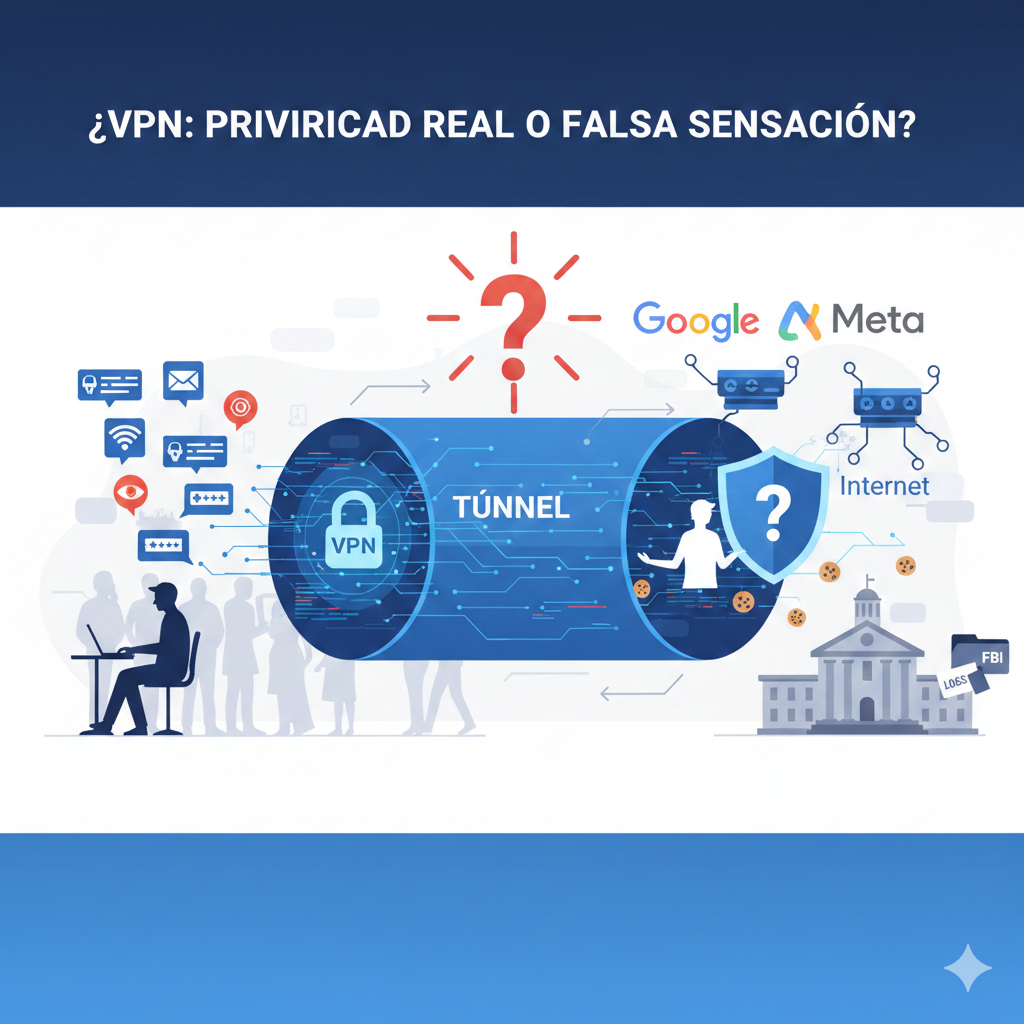
The acronym VPN stands for Virtual Private Network. As its name suggests, it is a technology that uses a public network like the Internet to create a private network or encrypted tunnel between the user and a server (point A and point B). This prevents other users on the public network from seeing the traffic circulating within that private network.
It is as if you and another person were in a public place where everyone speaks Spanish, but you start speaking in German. Despite being in a crowded place where everyone can hear you, they cannot understand what you are sharing; this achieves a certain degree of confidentiality. Of course, a VPN is more secure, since by employing encryption (or “encripción,” as many know it), information is protected much more robustly than just by switching to a different language—the language is just an example.
VPNs were originally created in the corporate world so that employees could connect to their corporate networks securely over the Internet. This way, companies did not have to pay for direct lines between branches or executives. Over time, their use became popular due to concerns about online privacy, censorship, and geolocation.
a) Privacy on public networks: If you are on a network you do not trust (for example, a café’s Wi-Fi, a public library, etc.), a malicious user could intercept your traffic and see what you transfer: sites you visit, usernames, passwords, etc. A VPN protects you by encrypting the information.
b) Partial anonymity: By routing your traffic, your IP becomes anonymized to remote sites and users, who will only see the identity of the VPN server.
c) Blocking your ISP: Your Internet Service Provider or ISP (like Telmex or similar) will not be able to see the specific sites you visit or the information you share.
d) Bypassing geographic restrictions: If there is site blocking or censorship in your country, you can choose an IP from another country to bypass these restrictions.
a) Tracking by advertising companies: Companies like Google or Meta rely on your digital fingerprint (browser fingerprinting), which includes data about your browser, operating system, and screen resolution, rather than just your IP.
b) Cookies and trackers: There are companies that track your digital habits through cookies and other tracking mechanisms that work regardless of whether you use a VPN or not.
c) Legal requirements: If the police issue a warrant, the VPN provider may be forced to hand over the logs (logs) of your activity. In some cases, this even makes the authorities’ job easier by having your history centralized.
d) Social engineering: A VPN does not protect you from phishing. If you are tricked into handing over your data or compromising your assets voluntarily, the encrypted tunnel technology will be useless. For example, if you connect to a fake network and they ask for your Gmail password and you type it in, the VPN did not help you at all.
Regarding logs (usage logs that include your real IP, connection times, and sites visited), many providers promise a “zero-logs” policy. However, there have been cases of companies that, after being subpoenaed by the FBI or the police, ended up handing over such evidence. Therefore, there is no total guarantee of anonymity if illegal acts are committed or if a government dislikes you.
Conclusion: A VPN can hide where you are connecting from, but not necessarily who you are.
The short answer is NO, at least not for most people. True anonymity requires much more than a VPN, such as:
Even in these cases, anonymity is very fragile: a single mistake and your identity will be exposed.
So this leads us to the question:
The answer is… it depends.
Privacy is fundamental, and any tool that helps preserve it is valuable. The important thing is not to underestimate or overestimate these technologies, so as not to fall into the trap of a false sense of security. If you keep an eye on the blog, I will help you stay safer.
Learn simple cybersecurity rules to protect your social media, WhatsApp, and bank accounts. A practical guide to avoid becoming an easy target.